Nuclides whose daughter sets the shield
A decay table gives the energies of the nuclide you look up. A source gives you that nuclide and everything it has decayed into. For most of the nuclides on this site the difference does not matter: the daughter is stable, or it is so long-lived that nothing has accumulated. For 7 of them it matters a great deal, and for 5 of those the figure that decides the shield belongs to the daughter rather than to the parent.
The extreme case is Ru-106. Its own beta endpoint is 0.0394 MeV, which stops in 0.0215 mm of acrylic — a figure that would suggest no shield is needed at all. But Rh-106 follows it with a half-life of 30.07 seconds, and its 3.54 MeV endpoint needs 15.0 mm, 697 times as much.
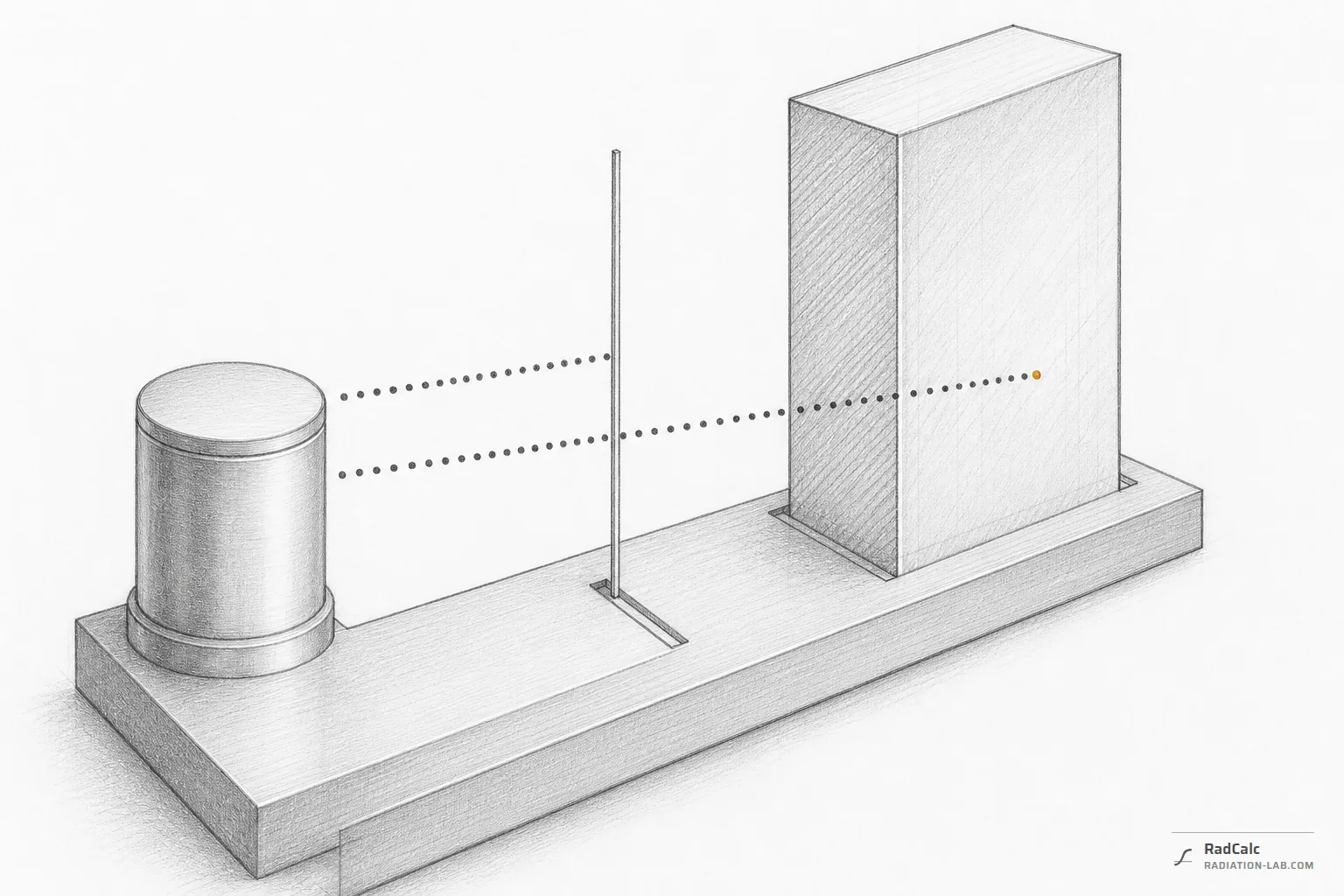
Beta endpoints, parent against daughter
| Parent | Daughter | Daughter half-life | Parent endpoint (MeV) | Daughter endpoint (MeV) | Acrylic needed (mm) | Factor |
|---|---|---|---|---|---|---|
| Ru-106 | Rh-106 | 30.07 seconds | 0.0394 | 3.54 | 0.0215 → 15.0 | 697× |
| Pb-210 | Bi-210 | 5.012 days | 0.0635 | 1.16 | 0.0517 → 4.21 | 81× |
| Ce-144 | Pr-144 | 17.28 minutes | 0.318 | 3.00 | 0.724 → 12.6 | 17× |
| Si-32 | P-32 | 14.268 days | 0.227 | 1.71 | 0.434 → 6.70 | 15× |
| Sr-90 | Y-90 | 64.05 hours | 0.546 | 2.28 | 1.57 → 9.28 | 5.9× |
Ranges are Katz–Penfold fits to the endpoint, so they are stopping thicknesses rather than attenuation lengths, and they carry about ±10%.
Time to ingrowth
None of these daughters has to be added to the source. Each one grows in from the parent until its activity matches, and because every daughter here is short compared with its parent, that state is reached and then held. The question is only how long a freshly separated source takes to get there — seven daughter half-lives puts it within a percent.
- Ru-106 → Rh-106: 3.51 minutes after separation.
- Pb-210 → Bi-210: 35.1 days after separation.
- Ce-144 → Pr-144: 2.02 hours after separation.
- Si-32 → P-32: 99.9 days after separation.
- Sr-90 → Y-90: 18.7 days after separation.
On any practical timescale, then, these parents are not encountered alone. A shield sized on the parent's own endpoint is undersized from the first day of use.
Bremsstrahlung and the choice of material
The same substitution changes which material to shield with. Stopping a beta converts part of its energy into X-rays, and the yield rises with both the beta energy and the atomic number of the absorber. That is why a beta shield is built from a low-Z material and backed, if the activity is high enough to need it, by a thin high-Z layer for the X-rays — never from lead alone. Sizing that decision on the parent understates the X-ray production, because the daughter's beta is the harder one.
| Parent | In acrylic, parent | In acrylic, daughter | In lead, parent | In lead, daughter |
|---|---|---|---|---|
| Ru-106 | 0.01% | 0.74% | 0.11% | 10.16% |
| Pb-210 | 0.01% | 0.24% | 0.18% | 3.33% |
| Ce-144 | 0.07% | 0.63% | 0.91% | 8.60% |
| Si-32 | 0.05% | 0.36% | 0.65% | 4.91% |
| Sr-90 | 0.11% | 0.48% | 1.57% | 6.54% |
Photon fields that belong to the daughter
The same thing happens with photons. Ge-68 carries no photon line worth shielding, yet a source of it has a photon field, because the daughter supplies one.
- Ge-68 → Ga-68 (67.71 minutes): air kerma rate constant 0.129 mGy·m²/(GBq·h), against no recorded line for Ge-68.
Cases that depend on the separation date
Where the daughter's half-life is long, how much of it is present depends on when the material was last separated, and no page can know that. Ir-192m2 → Ir-192 (73.829 days) falls into this group. The individual pages say what full ingrowth would bring and stop there.
Limits of this page
This is a one-step test. It compares a nuclide with the nuclide it decays into, and it says nothing about what happens further down a chain. Where the next nuclide is not carried in this dataset at all — Ra-226 and U-238 among them — the figures on those pages cover the parent's own emission only, and the pages say so rather than drawing a conclusion from them. Branching ratios are not used anywhere here, because the dataset does not carry them; the identity of a daughter follows from the decay mode and the atomic and mass numbers, and its half-life, endpoint and air kerma rate constant are read from the same tables as everything else.
Where to go next
- Nuclide data — the individual pages, each of which repeats the warning above for its own case.
- Shield materials for beta emitters — how thick, and what of: the bremsstrahlung argument for low-Z first.
- Beta dose rate and shielding — range and bremsstrahlung for an endpoint you choose.
- Methods and data — where the decay data come from and how the constants are computed.
- Limits of this dataset — why this comparison stops after one step.